|
| |
 s
people, we are more alike than different in our common goals of peace,
justice, a future for our children, a healthy planet and healthy environments
for all living things. As our worldviews are continually challenged by
new information, and as we become more aware of the consequences of our
collective actions, it becomes harder to live a "normal" life. To live
in adherence to our values, we must change not only our living patterns
but the basic systems upon which we depend. How we obtain the food we eat,
the clothes we wear, our shelter, our means of transportation, and education
for our children takes on greater meaning. These activities become political
acts--broadcasting our belief system and values--and in the process, each
of us must experience the contradictions and paradoxes of transformation.
The Earth, with all its complex, interlocking ecosystems, is the foundation of our lives. The greatest gifts are given freely to all living things. Indigenous peoples recognized that the relationship between humans, plants, animals and all life forms was sacred. They lived within a gift economy where exchanges helped to nurture relationships, communicate and create bonds between people and the natural world.   They
have driven indigenous people off their land, forced them into cities or
wage slavery, and torn them from their cultures. The United Nations accounting
system does not recognize the value of peace, an intact ecosystem, or the
unpaid labor of women (film review, Sojourn, Spring, 1997: Who's Counting?
Marilyn Waring on Sex, Lies & Global Economics). They
have driven indigenous people off their land, forced them into cities or
wage slavery, and torn them from their cultures. The United Nations accounting
system does not recognize the value of peace, an intact ecosystem, or the
unpaid labor of women (film review, Sojourn, Spring, 1997: Who's Counting?
Marilyn Waring on Sex, Lies & Global Economics).
By confusing money with real wealth, our civilization is rushing to destroy itself. Most of the world's work (paid and unpaid) is done by women, who hold only one percent of the world's wealth. As the ruling elite blame the world's ills on overpopulation, they subtly encourage the idea that masses of people are expendable. They promote the idea that industrialized nations are worth more than "developing" nations; the rich are idolized, and society's ills blamed on the poor. In reality, if truth were told, we would know that growing economies are indicative of the rape and exploitation of resources and that giving the displaced poor access to land, equality, education and family planning would dramatically decrease birthrates. Federal Reserve notes perpetuate the false economy. I think we should stick warning labels on our cash. I have a T-shirt with a dollar bill on it that clearly states, "Warning! Use of this product may cause apathy, laziness, selfishness, ignorance, loss of identity, greed,...environmental destruction, racial tension, murder, war, and impoverishment for others. Continuous and excessive use could render a permanent state of indifference to the welfare of those around you. Use at your own risk!" Money as a tool of the empire has produced an economy that has been disastrous for the culture. The weak links in the cultural fabric are those seduced by the toys of Western civilization, who 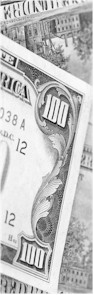 abandon their traditions in search of the quick buck and the "surface glamour
of the modern world." Where money intrudes, greed is kindled.
abandon their traditions in search of the quick buck and the "surface glamour
of the modern world." Where money intrudes, greed is kindled.
In his book Debt Virus, Jacques Jaikaran writes: "The most pernicious of all viruses is the one that confiscates the wealth of the productive elements of society and transfers it to the hands of a nonproductive few." When money is created by the banks and loaned to governments or business at interest, it becomes mathematically impossible to pay back all the money with interest (because the interest money is never printed). Not all debts can be repaid; foreclosures result. Wealth is continually transferred from the poor to the rich. Bankers, like magicians, do not like to reveal their secrets. Able to create money out of thin air; they have learned that belief is the key to their success. When people begin to doubt the purchasing power of money, banks fail and a currency collapses.  The Structural Adjustment Programs forced upon nations by the World Bank and the I.M.F. have meant exporting crops, devaluing local currency, cutting health and education spending, reducing wages, privatizing national industries, selling off natural resources, and removing tariff protections for local industries. Hunger, unemployment and inequality are the direct results of World Bank policies.
  new accounting system would respect and honor people for their integrity,
character, wisdom and gifts to society, as opposed to the amount of wealth
they can extract from society. Recognition of the gifts we have received
from the Earth, and a focus on our health, the health of the environment
and our quality of life would safeguard our living heritage for future
generations. If every baby born were loved, nurtured and given the opportunity
to develop all of its mental, spiritual and physical abilities, therein
lies the hope of humanity and the world. The dominant worldview is a dying
worldview. The holistic, cooperative worldview is being born and, given
the opportunity, the youngest members of society are quickest to grasp
its truths.
new accounting system would respect and honor people for their integrity,
character, wisdom and gifts to society, as opposed to the amount of wealth
they can extract from society. Recognition of the gifts we have received
from the Earth, and a focus on our health, the health of the environment
and our quality of life would safeguard our living heritage for future
generations. If every baby born were loved, nurtured and given the opportunity
to develop all of its mental, spiritual and physical abilities, therein
lies the hope of humanity and the world. The dominant worldview is a dying
worldview. The holistic, cooperative worldview is being born and, given
the opportunity, the youngest members of society are quickest to grasp
its truths.
 A gift economy existed on this continent before its history was written. Nature was abundant and the relationships among people, the Earth, the animals and plants were sacred. Money, or wampum, held a special meaning to people living within a gift economy. Feathers, stones and shells--worked to become objects of beauty--held a promise, a consolation, a message far beyond their material features. Exchanges promoted relationships and bonds between individuals, families, communities, and distant cultures. Wampum had a very different meaning and dynamic from the money system introduced by the Europeans. When the settlers heard that shells had value, they massacred the Indians who lived near where they were found. Believing they could purchase land with shells and beads, they missed or ignored the treaty aspect of the exchange. The value of the beads was not in their beauty, physical properties, or utility but in their message and meaning. The settlers were oblivious to this, since their focus was conquest and the acquisition of land and resources. Jerry Martien's book The Shell Game: A True Account of Beads and Money in North America explains this in detail. To quote from the back cover, "He shows how a gift relationship based on beads was replaced by monetary relations based on credit, and how the ancient ways of bookkeeping exemplified by the Iroquois' wampum exchange were replaced by a social contract based on scarcity and deficit."  Money as a tool can be impersonal, anonymous and destructive or it can be designed to build a world based upon respect and healthy relationships. Explaining the monetary system to most folks is not easy. It shatters too many long-held belief systems. It is much easier to explain this to first-graders, who quickly grasp the main ideas and have little to unlearn. In one sentence: Our current monetary system concentrates wealth and power, destroying the Earth in the process; we need to create a new system that redistributes wealth and power, healing the Earth in the process. The shared values of richly diverse communities are giving rise to regional or bioregional currencies. The old system relied on fear to control others, while the new systems nurture people and life. The old system depended on "experts" who imposed their ideas upon the many. The new system takes us from a "smart" culture to a "wisdom" culture in which all are respected and we recognize that our own well-being cannot be separated from the well-being of all people. With our current monetary system at a critical state now, local currencies can provide a wonderful safety net in addition to modeling a new system that is more conducive to life. Local currency can be a way to transition from a pure exchange economy towards a gift economy. This moves us toward an egalitarian, cooperative, respectful exchange by supporting face-to-face relationships. As we raise our awareness, we can move to better, more enlightened systems.   n the
present system, people receive interest on money saved or kept out of circulation.
This encourages hoarding. "Money in the bank" or "investments" provides
a false sense of security in a world of scarce national currencies. This
hoarding practice has separated the wealthiest twenty percent from the
plight of the vast majority who suffer under increasingly harsh conditions. n the
present system, people receive interest on money saved or kept out of circulation.
This encourages hoarding. "Money in the bank" or "investments" provides
a false sense of security in a world of scarce national currencies. This
hoarding practice has separated the wealthiest twenty percent from the
plight of the vast majority who suffer under increasingly harsh conditions.
In 1890 Silvio Gesell formulated a theory of money as revolutionary as the notion that despite appearances, the Earth circles the sun. Gesell suggested charging a negative interest, called demurrage, to inhibit hoarding and keep money in circulation. His ideas were tested by the mayor of Woergl, Austria in July, 1932. The holder of this local currency was charged a one percent stamp tax on the first of every month to maintain the value of the certificate. To avoid the charge, people spent their money quickly. Money flowed in the community and people even paid their taxes in advance. Jobs and public works projects flourished in Woergl. The town was able to repair its streets, build a ski jump and a bridge, and provide relief funds for those unable to work. This experiment inspired hundreds of local currencies in other parts of Europe, in Canada, the United States and Mexico. The central bank of Austria eventually put pressure on the government to declare the system illegal. Thriving local currencies in Germany were also made illegal. I read an excellent paper entitled "When Money Power--Suppressing Successful Money Reform--Prepared The Way For Hitler." According to the paper, when Germany was doing well, Hitler could not win an election. It was only when a vast number of people were unemployed that he was able to win office and target minorities for the ills of society. A top economist urged Franklin D. Roosevelt to encourage local currencies. However, Roosevelt opted for "The New Deal," which flooded the nation with Federal Reserve Notes, putting an end to currency experiments in the United States, and effectively centralizing power. An ethical international green currency with a demurrage feature could fund healing for the planet and put energy where it is most needed--e.g., renovation and reforestation projects all over the world. This would be a way to channel excess money out of a speculative, destructive cyber-casino, into real projects that benefit people and life-forms.
We are in a period of chaos, paradox and transformation. This
is reflected in relationships, institutions and organizations.
 We used some of Boal's techniques in our workshop, "Global Trade Policy: Governance by Corporations." We were also inspired by a group in Arcata who actually proposed a town hearing on the questions, Can we have a democracy when corporations have so much wealth and power? What city council policies and programs do we want in order to ensure democratic control over corporations conducting business with the city, and to protect the health and well being of the community and its environment? We divided into six groups, each playing a part—local government, Women's International League for Peace and Freedom, environmentalists, concerned citizens groups, "workers" and corporations. We enacted hearings, and tried to create language to help oppressed people gain sovereignty and rights over the corporations. This was very empowering and inspiring.  Problems imply the responsibility to change a behavior or system. That is scary, and creates resistance because we don't know whether the solution will be worse than the problem. It is more comfortable to be with something we are familiar with. At the end of the social movement process, however, the alternative becomes more compelling than anything else. That is how slavery was abolished, and how women got the vote. I feel we are moving towards this compelling stage now with local currency. Some localities are moving forward more quickly than others, but any successes will help bring along other communities. The United States is behind other countries such as France, England, Australia, and New Zealand in this movement. Yet what we do will have a huge effect in other parts of the world through a good example. We could help relieve the burden of the industrialized world's consumption of three-quarters of the world's resources. I have learned five basic leadership principles that can be applied to any type of activism or leadership activity. These are beautiful principles that we should all know and follow: 1) Challenge the process/system
A friend of mine, Tom Atlee, who writes about
"co-intelligence" says, Things are getting better and better and worse
and worse, faster and faster all the time. It's true. There are wonderful
discoveries, insights, breakthroughs and projects occurring each day that
are rarely heralded in the mainstream media but there are also horrendous
things going on which are even more obscured by the corporate press. Our
challenge is to allow the worst systems to collapse or die, and to nurture
healthy, just, sustainable and healing alternatives.
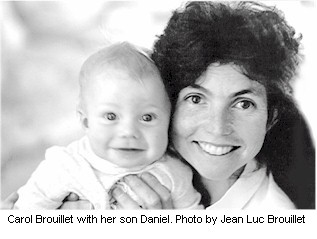
 arol
Brouillet, from Palo Alto, is an international speaker on behalf of local
currencies and feminist economics. This article is a summary of a Sojourn
Interview and a compilation from her papers, Reinventing Money, Restoring
The Earth, Re-weaving The Web Of Life, which won an honorable mention
from the Millennium Institute as one of the best ideas for the 21st century,
and The Feminist Perspective. The latter was written for an economic
summit in Denver last year (coinciding with the G7 meeting) at which Carol
moderated a panel on local currencies. arol
Brouillet, from Palo Alto, is an international speaker on behalf of local
currencies and feminist economics. This article is a summary of a Sojourn
Interview and a compilation from her papers, Reinventing Money, Restoring
The Earth, Re-weaving The Web Of Life, which won an honorable mention
from the Millennium Institute as one of the best ideas for the 21st century,
and The Feminist Perspective. The latter was written for an economic
summit in Denver last year (coinciding with the G7 meeting) at which Carol
moderated a panel on local currencies.
She has created a model for a global currency called "Gaia Futures," backed by renewable energy and environmentally sound products. Its negative interest rate would maintain the system and fund special projects to meet pressing human and environmental needs. Grants and interest-free revolving loans of Gaia Futures would provide seed money for local endeavors. She has been nurturing local currency movements, and hopes to connect them to create regional, bioregional and global currencies that will redistribute wealth and power--healing the Earth in the process. |
| Bone
Woman ~ Weaving Worlds Together Creating Tribal Crossroads ~ From the Publishers ~ Making Democracy Work National vs Local Currency ~ Reweaving the Web of Life Spiritual Community on the Internet |

 of
foreign exchange transactions consist of sheer speculation. Less than 5%
of them have to do with real goods or production, and these are dominated
by the largest 500 multinational corporations.
of
foreign exchange transactions consist of sheer speculation. Less than 5%
of them have to do with real goods or production, and these are dominated
by the largest 500 multinational corporations.
 or
most people living in industrialized nations, the cost of money is hidden,
included in the price of the goods and services we buy--on the average,
about fifty percent of the cost of the necessities of life. If interest
rates were abolished, most people would be twice as rich or be able to
maintain their standard of living by working half as much as they do now.
or
most people living in industrialized nations, the cost of money is hidden,
included in the price of the goods and services we buy--on the average,
about fifty percent of the cost of the necessities of life. If interest
rates were abolished, most people would be twice as rich or be able to
maintain their standard of living by working half as much as they do now.